
AI Upskilling for the Visitor Economy
Helping North East tourism businesses move from AI awareness to practical adoption
The Challenge
Artificial Intelligence is rapidly changing how visitor economy organisations market themselves, communicate with customers and manage internal operations. However, many tourism businesses were unsure where to begin. While interest in AI was high, confidence, practical skills and organisational readiness varied significantly across the sector.
Destination North East England commissioned Service Design North and Northern Latitude to design and deliver a regional programme that would help businesses understand the opportunities and risks of AI, build practical skills and identify meaningful applications within their own organisations.
Working alongside AI specialist Dr Yulia Dzenkovska, we helped ensure the programme was grounded in the realities of the visitor economy, translating emerging technologies into practical tools that tourism businesses could immediately apply.
Our Approach
Successful technology adoption is rarely about technology alone. It requires confidence, relevance and practical application.
Together, we designed a three-stage programme that combined introductory learning with hands-on experimentation and tailored business support. The programme included an online taster session, three regional masterclasses and one-to-one mentoring support for participating organisations.
While Dr Dzenkovska led on AI expertise and programme design, Northern Latitude brought visitor economy insight, sector knowledge and practical examples drawn from tourism, hospitality, culture and heritage organisations.
This combination ensured participants could see not only what AI can do, but how it could help solve real-world challenges within their own organisations.
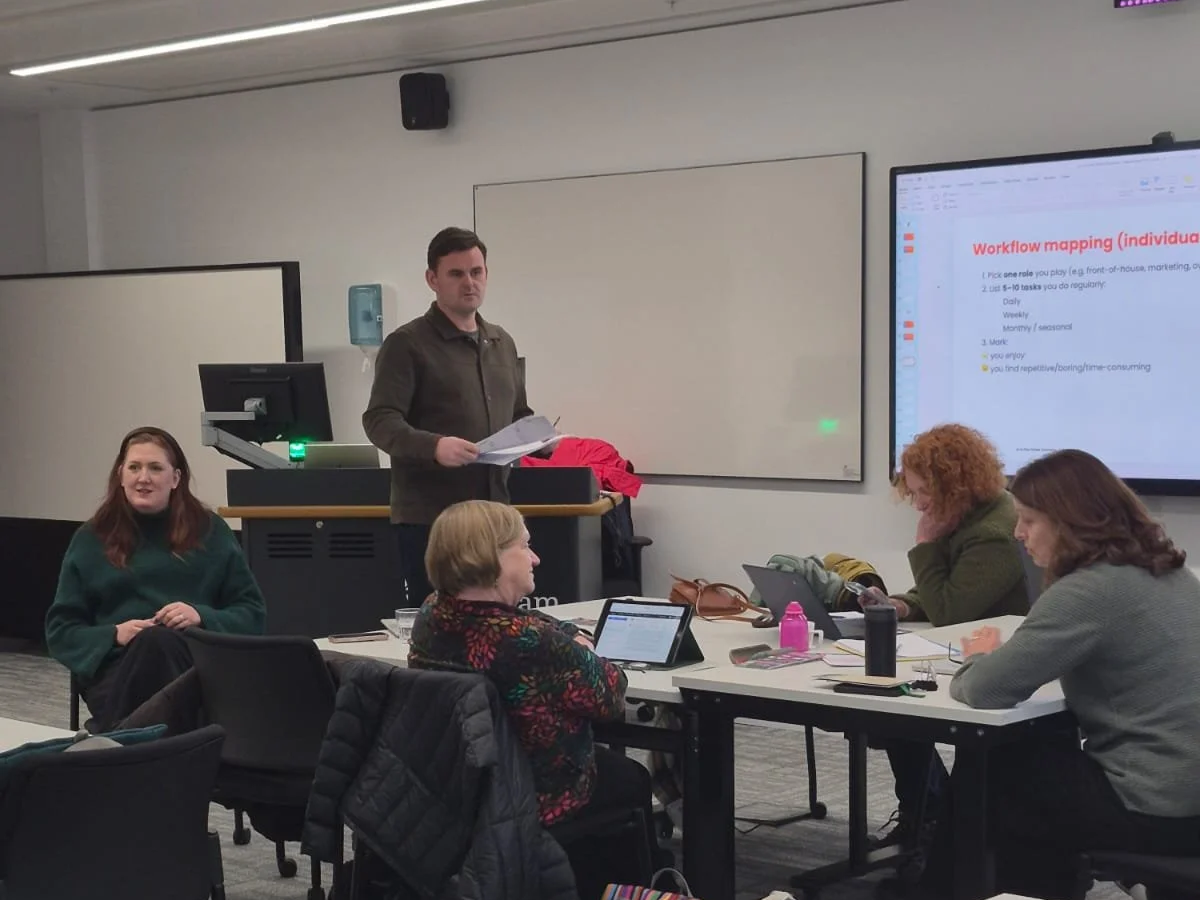
Workshop in Durham. These also took place in Alnwick and Newcastle Upon Tyne.
What We Did
Between December 2025 and March 2026, we delivered a programme that engaged businesses and organisations from across County Durham, Newcastle, Gateshead and Northumberland.
The programme included:
Three full-day regional AI masterclasses.
Twenty hours of tailored one-to-one support.
Practical demonstrations of AI tools and workflows.
Visitor economy-specific examples and case studies.
Guidance on responsible and ethical AI adoption.
Support for identifying opportunities within marketing, operations, customer service and organisational development.
Participants represented accommodation providers, visitor attractions, museums, heritage organisations, cultural venues, tour operators, destination management organisations and public-sector partners.
A key part of our role was helping organisations move beyond generic discussions about AI and identify practical, achievable opportunities for implementation.
Outcomes & Impact
The programme engaged 44 participants from 34 organisations and delivered measurable improvements in confidence and capability.
Evaluation showed:
41% confidence growth amongst participants in Durham.
47% confidence growth amongst participants in Newcastle.
35% confidence growth amongst participants in Alnwick.
Participants identified immediate applications for AI in marketing, content creation, customer communications, accessibility, reporting, research, operational efficiency and internal workflows.
Perhaps more importantly, organisations began to shift from asking "What is AI?" to exploring "How can we use AI to solve specific problems?"
Through the one-to-one support programme, businesses tested new approaches to content creation, customer engagement, planning, reporting and administration. In many cases, the most valuable applications were not headline innovations but practical improvements that reduced friction, saved time and created additional organisational capacity.
The programme evaluation estimated a potential first-year value of approximately £58,000–£60,000 across participating organisations.
What We Learned
One of the strongest findings from the programme was that individual readiness often exceeded organisational readiness.
Many participants were enthusiastic about adopting AI and quickly developed the confidence to experiment independently. However, organisations frequently lacked the governance, policies, leadership support and internal processes needed to embed AI effectively.
This suggests that future support programmes should move beyond introductory training and focus increasingly on organisational change, leadership development and responsible implementation.
For us, the project reinforced the importance of combining technical expertise with sector-specific knowledge. Businesses do not need more information about AI. They need support applying it in ways that are relevant, practical and aligned with their organisational goals.
Looking Forward
The programme demonstrated that a regionally delivered model of training, mentoring and practical support can accelerate AI adoption across the visitor economy.
As organisations move from experimentation towards implementation, there is growing demand for support that combines technology, business change and sector expertise.
We continue to work with destinations, attractions and tourism businesses to identify opportunities for innovation, improve organisational capability and help teams adopt new technologies with confidence.